
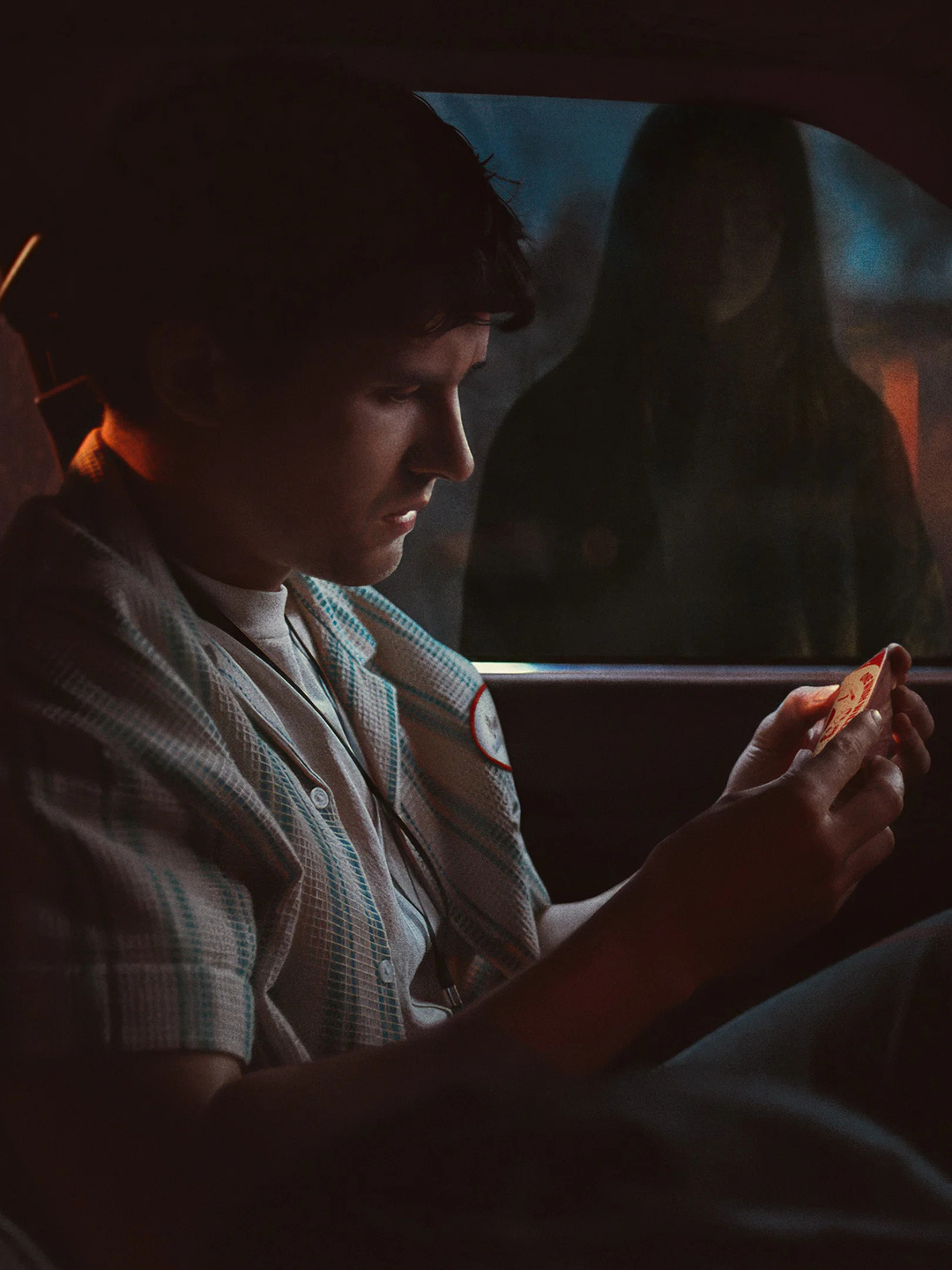
Around the midway point of Curry Barker‘s Obsession (2026), the film pulls what could be its most pivotal moment, narratively and stylistically. Bear (Michael Johnston) is waking up from his sleep confused and, as his face suggests, wary. He finds out that Nikki (Inde Navarrette), his supposed lover, is missing from the bed they shared earlier that night. Intuitively, he looks around, glancing at the bedside clock and then fixating his sight across the room. The camera then does its signature move: not moving at all, bizarrely staring at the space for a few seconds too long, only to reveal that Nikki has been lurking in the corner, obsessively watching Bear sleep.
In other horror films, what the camera does there is a setup for jumpscares, a disorienting silence before a shocker. As the camera fixates on one side, Nikki comes out of the corner unannounced, catching Bear, and the audience, off guard. The camera stays intact as Nikki tells the puzzled Bear that she is merely watching him sleep. “You look cute when you’re sleeping,” she says. “Wearing my sweater?” Bear asks, to which Nikki replies that she likes the smell. Only then does the camera move away, before fixating again on a mirror reflecting a facial figure that is definitely but not quite like her, wailing, “I feel like you don’t love me as much as I do.” With how the scene rolls at a discomforting face value, Obsession is doing what traditional horror does; yet at the same time, by doing the oldest trick in the book, the film is making its argument. The camera is doing the heavy lifting, asking us what the intention of staring a little too long would be if not obsession enacted.
The Camera is the Obsession
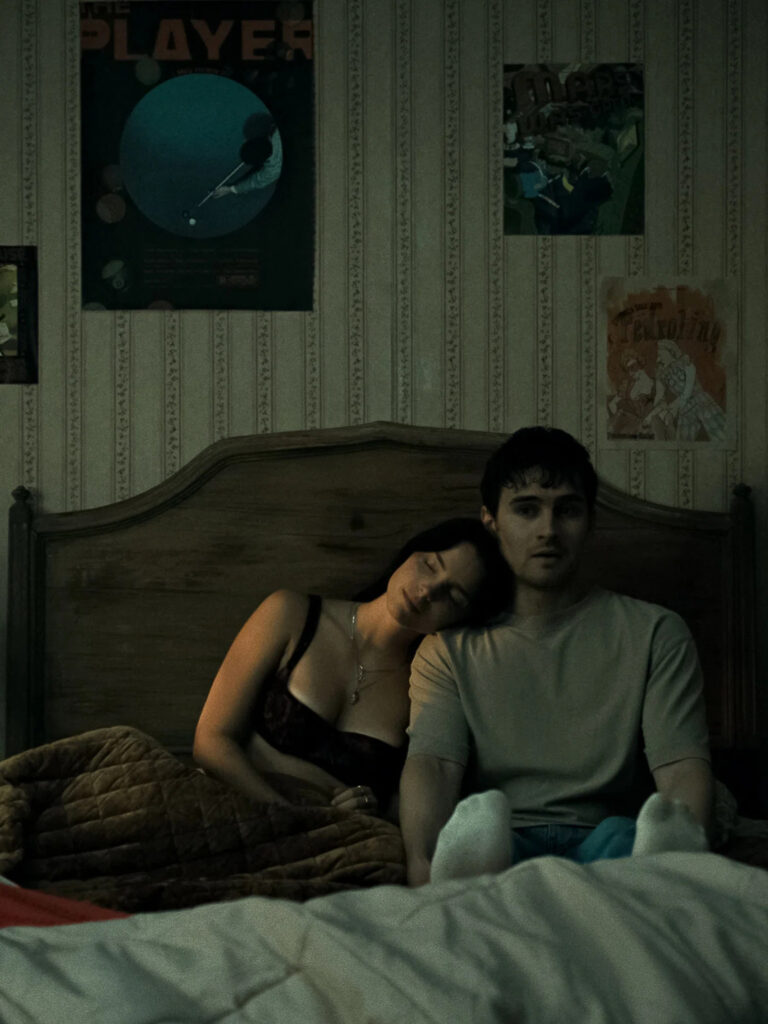
The camera does not simply observe obsession; it performs it. Initially it is a neutral observer as Obsession establishes its world: four friends and coworkers around a table, Bear, Nikki, Ian (Cooper Tomlinson), and Sara (Megan Lawless). Bear has feelings for Nikki, obsessed at some level, but as their mutual friends suggest, Nikki sees him as something closer to a little brother. It doesn’t help that he is timid and sentimental, brimming with insecurity and a fear of being vulnerable.
He intends to confess his feelings and even rehearses it, but when push comes to shove, he crumbles. It’s not as though she doesn’t give him the chance; at one point she asks directly if he likes her, to which he replies that he does, as a good friend. Succumbing to his own insecurity and opting for the status quo, he chooses to lose before even trying, a self-serving quality that will keep returning to him.
Out of frustration, he breaks the “One Wish Willow,” a novelty toy said to grant a wish, one he had planned to give Nikki before losing the courage to do so. “I wish Nikki Freeman loved me more than anyone in the world,” he wishes. Silence follows. Then the camera stops being a neutral observer. There is a sense of deliberation now in how it fixates its gaze, making use of negative space, speaking a visual language that feels itself obsessed with what it watches.
That deliberation is only possible because Barker, who also penned the script, serves as the film’s editor, giving himself the authority to let a shot overstay its welcome, to hold past the point where a gaze has normally served its purpose. Immediately after the willow breaks, the camera stays still, watching from behind Bear’s POV as Nikki’s silhouette stands motionless on her porch. It holds there at least two seconds longer than it should, long enough to make the air feel wrong, to make the audience hold its breath the way you hold yours when someone’s eyes stay on you just past the point of comfort. This is the film’s turning point. Nikki will soon become someone else entirely, and before long the two of them start dating, though dating is perhaps an understatement for what follows.
Barker plays his cards smoothly in delivering the “careful what you wish for” premise the film administers in every promotional material. Obsession plants Bear’s defining trait early, self-preservation, and allows audiences to deduce it from how he moves through the world. His carelessness with the wish is therefore self-fulfilling. This is where the horror emerges from behind the ineptness, disguised as indecisiveness; this is where he pays the cost of his cowardice. Barker obscures this through a familiar mechanism, faux sympathy for the perpetrator, the kind that makes you feel implicated before you have agreed to be, the same trick Black Mirror‘s Shut Up and Dance pulled so devastatingly.
The Nikki he is now with is not remotely the same as the Nikki he admires. She flips the obsession entirely, turning what should be a dream into an overbearing dungeon where her unwavering presence suffocates the very thing he wished for. This leads to the story’s ever-present debate: who is the real victim? But the victim of circumstances is not the same as the victim of a choice, and the film is quite bleak in making that distinction.
The Complicit Gaze
Obsession, the act not the film, can get ugly fast; and that is what the film is trying to say. Bear’s obsession becomes Nikki’s possession, but the question is whether it is ever truly his. The film strips Nikki of her real traits early on. What remains is a shell of what she has been, possessed by Bear’s projection which in turn possesses him instead, filling him with every baggage he is never ready to carry. The camera does the work of giving that obsession a visual surrogate, locking characters in place longer than they should be and filling the space with dread that comes from deduction rather than explicit scares. Yet the camera does more than that one task.
When Barker pulls the faux sympathy card, he engineers it so that audiences feel the discomfort of feeling bad for Bear. The gap between what is shown on screen and what we imagine inside the characters’ psyche becomes the site of moral conflict, and the camera has already made us inhabit that gaze before we consented to it. Through the lens and by extension the editing, we are already looking too long, a beat past the point where we should have looked away, before we understand what staring too long costs the person being looked at. The film makes us feel what complicity feels like from the inside, which is why it is so conflicting.
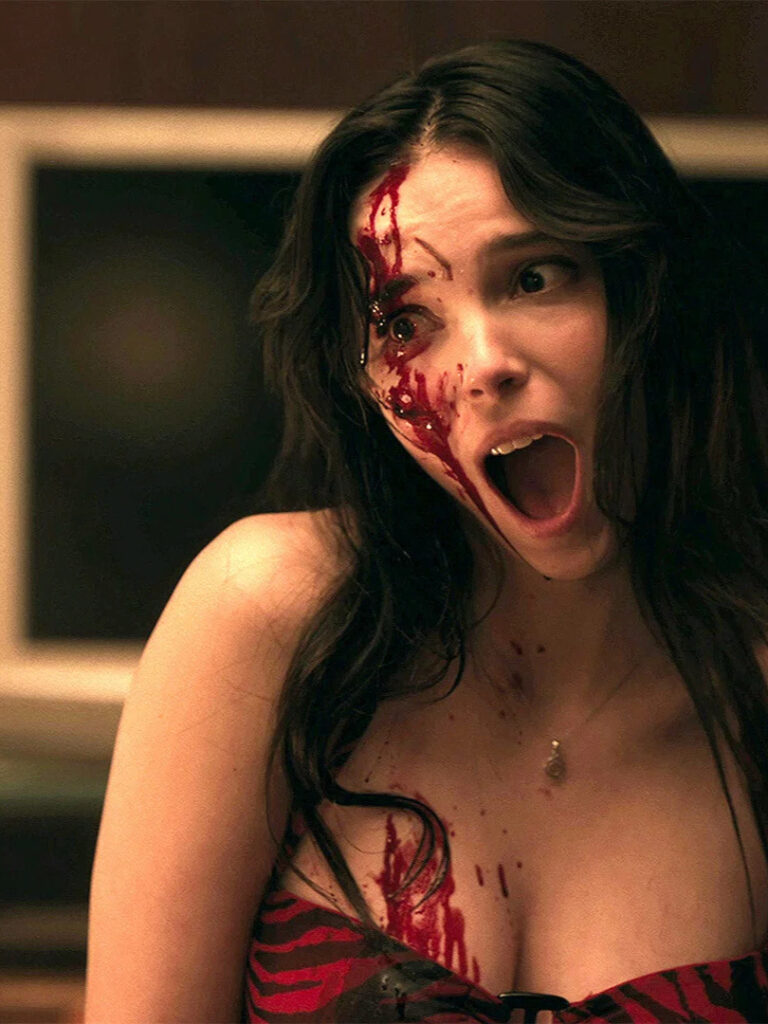
Yet the same camera also shows us earnestly where to look. Bear’s self-preservation keeps returning, and the camera makes it legible without requiring close reading, the contradiction sitting plainly in how he responds to everything around him. There is one pivotal scene where the real Nikki, the one we meet at the beginning of the film, makes her presence known and asks Bear to end her suffering. Any sensible person would feel the weight of that plea, because by this point it is no longer possible to believe her condition is a consequence of her own doing; it is something imposed on her entirely. Bear’s first reaction, however, turns inward. “What’s so bad about being with me?” he deflects. He has not changed at all from where we first knew him, only now he holds a power he never earned and still refuses to examine. It is a point of no return.
The same sentiment recurs all the way to the very end, self-preservation that keeps going even when the costs have piled up, even when it no longer looks defensible, even when it is dressed as a sacrifice. The camera captures that without flinching, keeping us staring even when it shatters whatever sympathy we carried or whatever hope of redemption we harbored. Even when there is only one exit plan, Obsession keeps showing us who the victim has always been. Do we still believe there is an alternate reading if the camera has made us complicit and never told us otherwise? One last question: who pays the cost?
Leave a Reply